Showing posts with label PHP. Show all posts

Tuesday, September 21, 2010

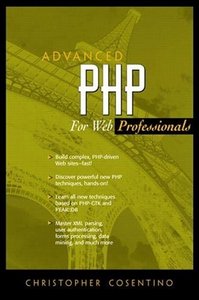
Advanced PHP for Web Professionals


Advanced PHP for Web Professionals 
 Pages: 368 | CHM | Size: 1,27 MB

Take your PHP programming skills to the next level, with this hands-on, example-rich tutorial! In Advanced PHP for Web Professionals, best-selling PHP author Christopher Cosentino brings together dozens of powerful new techniques for building serious Web applications. Learn how to manage sessions more effectively, create better forms, develop custom error handlers, build database-independent Web applications with PEAR::DB, parse XML files, authenticate users via database query, build cross-platform client apps with PHP-GTK, and much more!

Download Link

Sunday, June 13, 2010

PHP for the World Wide Web:


PHP for the World Wide Web: 
Visual QuickStart Guide, 3rd Edition 
 480 pages | PDF | 10,1 MB 

With PHP for the World Wide Web, Third Edition: Visual QuickStart Guide, readers can start from the beginning to get a tour of the programming language, or look up specific tasks to learn just what they need to know. This task-based visual reference guide uses step-by-step instructions and plenty of screenshots to teach beginning and intermediate users this popular open-source scripting language. Leading technology author Larry Ullman guides readers through the new features in PHP 6, focusing primarily on improved support for handling any language in a Web site.

Other addressed changes include removal of outdated and insecure features, plus new functions and more efficient ways to tackle common needs. Both beginning users, who want a thorough introduction to the technology, and more intermediate users, who are looking for a convenient reference, will find what they need here--in straightforward language and thorough readily accessible examples.


Thursday, January 28, 2010

Web Publishing with FileMaker and PHP


Web Publishing with FileMaker and PHP
English | 2007 | 432 pages | PDF | 5,4 MB


Whether you are a FileMaker developer who is new to web publishing, a web developer who is new to FileMaker, or a complete beginner looking to put your data online, this book is for you.
In Part I, you learn the basics of how web publishing works and how to write your own HTML and PHP.
In Part II, you learn how to build a FileMaker database and install and configure the FileMaker Server to host the database. In Part III, you learn how to put it all together to create web pages that talk to your database and allow people to view the data and, if you like, modify it. Throughout the book, publishing a FileMaker Product Catalog to the web is used as an example. Each chapter builds on the previous chapter. When you are done, you will have a working website!
Detailed information on how to…
Master web publishing
Read and write basic HTML
Read and write basic PHP
Build a FileMaker database
Install and configure FileMaker Server
Publish your FileMaker data to the web
Work with portals and container fields
Repurpose your FileMaker layouts on the web


Thursday, December 31, 2009

PHP for Teens


PHP for Teens
| 300 pages | PDF | 7 MB |

Don't limit the functionality of your web site! If you're ready to create interactive, dynamic pages for your site, then PHP for Teens is ready to show you how. You don't need any experience with 
PHP to begin. You'll learn everything you need to know along the way.

The topics covered by PHP for Teens will get you up and running whether you're using a PC, a Mac®, or Linux®. You'll cover everything from basic design and introductory PHP concepts to variables, expressions, and operators. You'll also get a quick overview of HTML and PHP form design. Take control of your web site using the power of PHP!


Wednesday, December 23, 2009

PHP Team Development


PHP Team Development
|150 pages | PDF | 2.7 MB|

Easy and effective team work using MVC, agile development, source control, testing, bug tracking, and more
* Work more effectively as a team by breaking up complex PHP projects into manageable sub- parts
* Develop code that is much easier to maintain with source control, agile principles, and project tracking
* Apply techniques related to process models, collaboration among team members, and continuous long-term improvement
* A precise guide with examples to illustrate practical benefits In Detail

Given the nature of the business environment today, organizations that want to build value-added enterprise PHP applications need a team of PHP people rather than an individual.
You've got a team! What next? Customizing such applications to meet with organizational objectives and maintaining these applications over time can be quite a tedious task for your team with so many people involved.

In this book, you will explore how you can break up complex PHP projects into simple sub-parts that multiple team members can work on. The book highlights the use of the MVC pattern for separating concerns in the application and agile principles to deliver code that works.

You will learn to blend the simplicity and power of PHP with evolving software engineering principles and tools to easily develop code that is easy to maintain. With this book in hand, you know how to avoid getting muddled up while working in a team and achieve success on your project with effective team work.

What you will learn from this book?

* Reduce your development time by using MVC to break down complexity in PHP projects
* Effectively use PHP frameworks to achieve project success
* Master the concepts of effective collaboration, choosing the right process, and continuous long-term process improvement
* Apply agile methodologies and pick up the practices that best suit your project
* Catch and eliminate bugs early using source control and bug tracking tools Approach

This book looks into PHP projects mainly from an enterprise view. The author's experience enables him to give you an overall picture of PHP projects and discuss factors that contribute to project success in a clear and precise manner.

Each chapter focuses specifically on how the techniques covered will make team work easier. Examples (rather than abstract best practices) are used to illustrate the practical benefits.

Who this book is written for?

This book is for PHP developers who work in teams on complex PHP projects. With this book in hand, it is easy to discover the secrets of successful PHP projects that meet today's complex enterprise demands.

This book can also be useful for project managers who are looking to be successful with PHP projects. Those who are stakeholders in PHP projects, such as clients, or those who want to sponsor PHP projects, can also learn what to expect and how to deal with a PHP project team with this book.